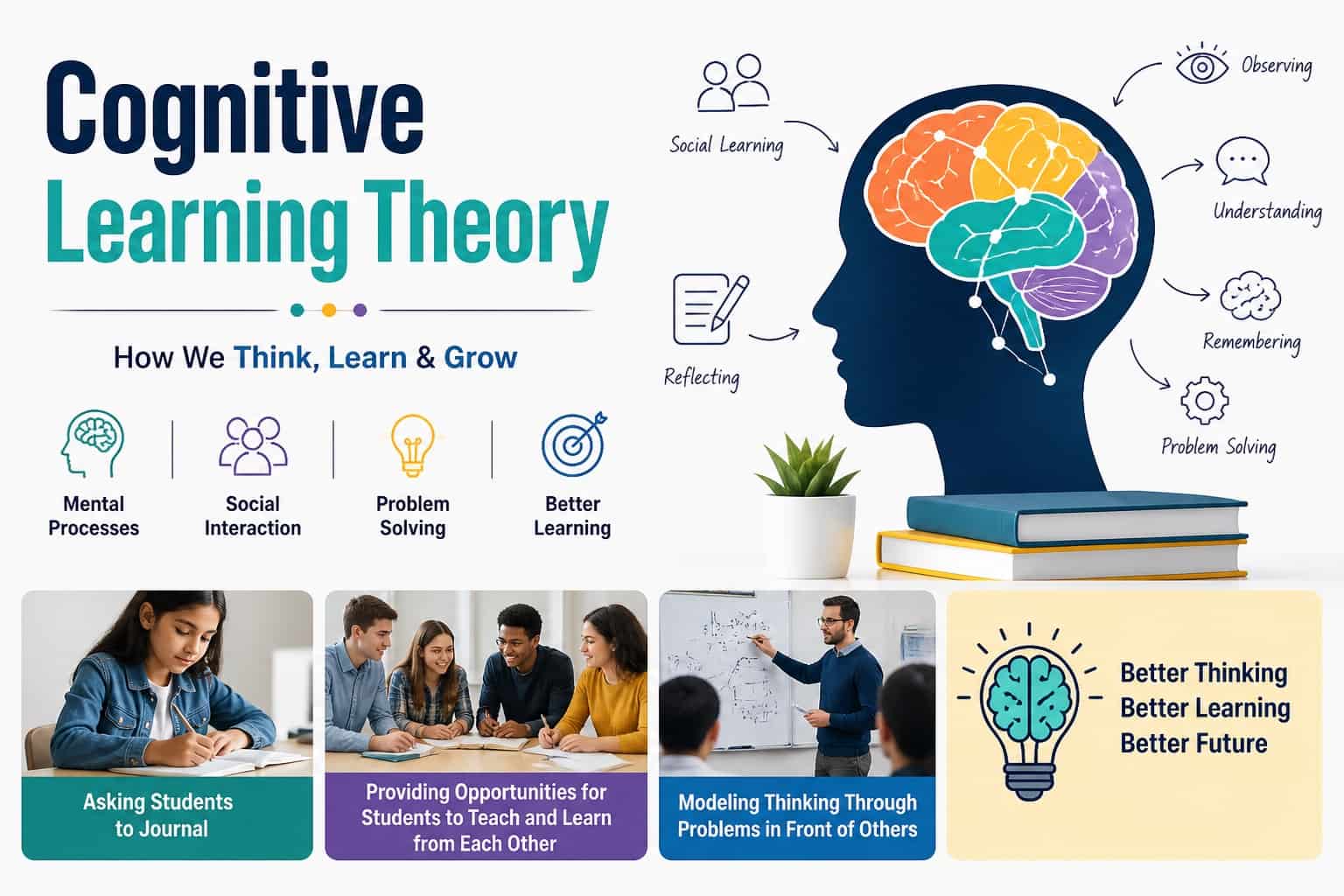
Cognitive Learning Theory is one of the most important concepts in modern education and psychology. It focuses on how people think, understand, remember, and learn new information. Unlike traditional theories that only look at behavior, this theory explains that learning happens inside the brain through mental processes like memory, problem-solving, and decision-making. In simple words, it tells us that learning is not just about reacting to things, but about understanding and processing information deeply.
One of the key parts of Cognitive Learning Theory is its connection with Social Cognitive Theory, which was developed by psychologist Albert Bandura. This theory explains that people learn not only from their own experiences but also by observing others. For example, students often copy the behavior of teachers or classmates. This process is called observational learning, where attention, memory, and motivation play an important role in shaping behavior.

Website Design Company in Ghaziabad webads24
Another related concept is Behavioral Cognitive Theory, which combines behavior and mental thinking. It explains how internal thoughts influence actions and learning outcomes. Both theories work together to show that learning is influenced by both internal (mind) and external (environment) factors.
In today’s education system, teachers use many practical strategies based on Cognitive Learning Theory. For example, asking students to journal helps them express their thoughts and reflect on what they have learned. It creates a safe space where students can think deeply and improve their understanding. Similarly, providing opportunities for students to teach and learn from each other helps build confidence and improves knowledge through interaction.
Another powerful technique is modeling thinking through problems in front of others. When teachers solve problems step-by-step in front of students, it shows that learning is a process, not something instant. This encourages students to try, make mistakes, and learn without fear.
Cognitive Learning Theory is widely used in classrooms, online learning platforms, and even in daily life. It helps students become active learners instead of passive listeners. On platforms like Instagram Story View, understanding such theories can help create better educational and informative content for users. Overall, this theory plays a vital role in improving teaching methods and enhancing learning experiences in a smarter and more effective way.
Cognitive Learning Theory | Cognitive Learning Theory Explained with Examples
Cognitive Learning Theory is actually a set of theories that stem from the term metacognition. Cognitive Learning Theory asks us to think about thinking and how thinking can be influenced by internal factors (like how focused we are, or how distracted we’ve become) and external factors (like whether the things we are learning are valued by our community or whether we receive praise from others when we learn).
Cognitive Learning Theory comes from the field of psychology and has roots going back to the beginning of Western philosophy. Important voices in this area include: Plato, Descartes, William James, John Dewey, and Jean Piaget.
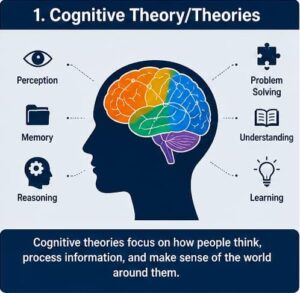
Cognitive Theory, also known as Cognitive Learning Theory, focuses on how the human mind processes information. It explains that learning is not just about memorizing facts but about understanding, thinking, and applying knowledge. This theory highlights mental processes such as perception, memory, reasoning, and problem-solving. It suggests that learners actively participate in their learning journey rather than being passive receivers of information.
Cognitive theories became popular as an alternative to behaviorism, which only focused on observable actions. Instead, cognitive approaches emphasize internal mental activities. When students learn something new, their brain connects it with previous knowledge, forming meaningful patterns. This helps them retain information for a longer time and apply it in real-life situations.
In education, Cognitive Theory encourages teachers to design lessons that promote thinking and understanding. Instead of rote learning, students are encouraged to analyze, question, and explore. This approach makes learning more effective and enjoyable. It also helps learners become independent thinkers who can solve problems on their own.
Cognitive Learning Theory is a well-developed area of educational theory, but here are two ideas that will get people started thinking about these ideas:
- Social Cognitive Theory/Theories: This perspective argues that learning is inherently social and happens in a social context. From this point of view, a learner’s social interactions with their peers, instructors, and others impact learning directly. An instructor who works to provide a positive social experience with regular opportunities for students to see that learning is valued and that others around them are engaged in the process will be successful at encouraging learning.
- Behavioral Cognitive Theory/Theories: This perspective argues that a person’s thoughts determines their actions and feelings, and ultimately their ability to learn and their enjoyment of learning. For example, students who believe they “don’t like to read” will find reading more difficult, and students who believe they are “good at art” will try harder and enjoy art more.
These two ideas work together well. Social Cognitive Theory focuses on both internal and external impacts on learning while Behavioral Cognitive Theory explores the impact of internal forces alone. They are not mutually exclusive ideas.
Learning activities that align with Cognitive Learning Theory include:
- Asking students to journal: Journaling leverages internal interests and motivations. Journaling also provides a “safe space” to take risks without the “threat’ of external judgement.
- Providing opportunities for students to teach and learn from each other: Peer-to-peer interaction provides a social context that illustrates that learning and knowing are valued in the group.
- Modeling thinking through problems in front of others: It can be both socially and personally (externally and internally) challenging to admit to not knowing or understanding something quickly. When instructors/teachers/trainers model working through problems/questions in front of learners, it can help to normalize the fact that learning and understanding takes time and is a process. Over time, having other learners in the group also have the opportunity to work through problems in front of others will strengthen the social norm that learning is a process and does not need to happen quickly or automatically.
Behavioral Cognitive Theory/Theories: Connecting Mind and Behavior
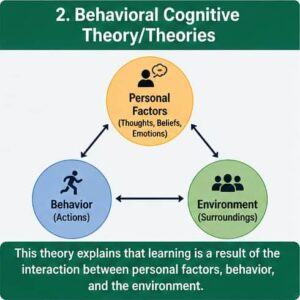
Behavioral Cognitive Theory combines ideas from both behaviorism and cognitive psychology. It explains that learning is influenced by both external factors, such as environment and rewards, and internal factors, such as thoughts and beliefs. This theory suggests that human behavior is shaped by the interaction between personal factors, behavior, and environment.
One of the key aspects of Behavioral Cognitive Theory is that people learn by observing others. For example, students often imitate teachers or classmates. If they see someone being rewarded for good behavior, they are more likely to repeat that behavior. This process is known as observational learning.
This theory also emphasizes self-efficacy, which means believing in one’s ability to succeed. When students feel confident, they are more motivated to learn and perform better. Teachers can support this by creating a positive learning environment where students feel encouraged and supported.
Behavioral Cognitive Theory plays a significant role in modern education. It helps teachers understand how students think and behave, allowing them to use effective teaching methods. By combining mental processes with behavior, this theory provides a complete understanding of how learning occurs.

Asking Students to Journal: A Powerful Cognitive Strategy
Asking students to journal is an effective teaching strategy based on Cognitive Learning Theory. Journaling allows students to express their thoughts, reflect on their learning, and organize their ideas. It helps them understand concepts more deeply and connect new knowledge with their personal experiences.
When students write regularly, they improve their thinking and writing skills. Journaling encourages self-reflection, which is an important part of learning. It allows students to analyze what they have learned, identify their strengths and weaknesses, and set goals for improvement.
This strategy also supports emotional development. Students can express their feelings and thoughts freely, which helps reduce stress and build confidence. It creates a safe space where learners can explore their ideas without fear of judgment.
Teachers can use journaling in different ways, such as asking students to write about what they learned in class, reflect on a topic, or share their opinions. This method makes learning more interactive and meaningful. It also helps teachers understand students’ thinking processes, allowing them to provide better guidance.

Providing Opportunities for Students to Teach and Learn from Each Other
Providing opportunities for students to teach and learn from each other is another important strategy in Cognitive Learning Theory. Peer learning helps students gain knowledge through interaction and collaboration. When students explain concepts to others, they understand the material more clearly and remember it better.
This approach encourages active participation in the classroom. Instead of just listening to the teacher, students engage in discussions, group activities, and collaborative projects. This makes learning more dynamic and enjoyable.
Peer teaching also helps develop communication and social skills. Students learn how to express their ideas, listen to others, and work as a team. It builds confidence and encourages responsibility, as students take an active role in the learning process.
From a cognitive perspective, teaching others strengthens memory and understanding. When students explain a concept, they process the information deeply, which improves retention. It also allows them to see different perspectives and learn new ways of thinking.
Teachers can implement this strategy by organizing group discussions, peer tutoring sessions, or collaborative projects. This method not only improves academic performance but also prepares students for real-life situations where teamwork and communication are essential.
Modeling Thinking Through Problems in Front of Others
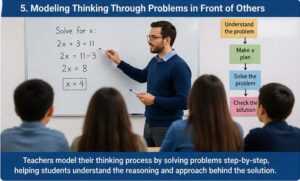
Modeling thinking through problems in front of others is a highly effective teaching technique. In this method, teachers demonstrate how to solve problems step by step while explaining their thought process. This helps students understand not just the answer but the reasoning behind it.
When teachers model their thinking, they show students how to approach complex problems. This includes identifying the problem, analyzing it, and finding a solution. It teaches students that making mistakes is a part of learning and encourages them to try different approaches.
This strategy also improves critical thinking skills. Students learn how to break down problems into smaller parts and solve them systematically. It helps them develop logical reasoning and problem-solving abilities.
Modeling thinking creates a transparent learning environment where students can see how knowledge is applied in real situations. It reduces confusion and builds confidence, as students feel more prepared to solve problems on their own.
Teachers can use this method in various subjects, such as mathematics, science, and language. By explaining their thought process clearly, they make learning easier and more accessible for students.
Conclusion
Cognitive Theory and its related approaches, including Behavioral Cognitive Theory, journaling, peer learning, and modeling thinking, have transformed modern education. These strategies focus on understanding how students think and learn, making education more effective and meaningful.
By asking students to journal, providing opportunities for peer learning, and modeling problem-solving, teachers can create an engaging and supportive learning environment. These methods not only improve academic performance but also develop critical thinking, creativity, and confidence.
In today’s world, where knowledge is constantly evolving, Cognitive Learning Theory helps students become independent learners. It prepares them to face challenges, solve problems, and adapt to new situations. Overall, it plays a crucial role in shaping the future of education and empowering learners to succeed.
In conclusion, Cognitive Learning Theory has completely changed the way we understand education and learning. It highlights the importance of mental processes such as thinking, memory, and problem-solving, rather than just focusing on external behavior. This approach makes learning more meaningful and long-lasting because it encourages students to actively engage with information instead of simply memorizing it.
The integration of Social Cognitive Theory/Theories and Behavioral Cognitive Theory/Theories further strengthens this concept by showing that learning is influenced by observation, environment, and personal beliefs. When students see others succeed, they feel motivated to learn and improve themselves. This idea of observational learning plays a major role in shaping behavior and academic performance.
Modern teaching methods are highly influenced by Cognitive Learning Theory. Techniques like asking students to journal allow learners to reflect on their knowledge and understand concepts deeply. It also improves creativity and self-expression. On the other hand, providing opportunities for students to teach and learn from each other creates a collaborative learning environment where students grow together.
One of the most effective strategies is modeling thinking through problems in front of others. This approach removes the fear of failure and shows students that learning takes time and effort. It encourages them to think critically and solve problems step by step, which is an essential skill in today’s world.
Cognitive Learning Theory is not limited to classrooms. It is also widely used in digital platforms, content creation, and online education. Websites like: Instagram Story View can use these principles to design better user experiences, create engaging content, and provide valuable learning resources to their audience.
As education continues to evolve, Cognitive Learning Theory will remain a powerful tool for both teachers and learners. It promotes active participation, critical thinking, and continuous improvement. By understanding and applying this theory, anyone can enhance their learning ability and achieve better results in both academic and real-life situations.
In the end, learning is not just about gaining knowledge—it is about understanding, applying, and growing. Cognitive Learning Theory helps make this journey more effective, interactive, and meaningful for everyone.
Also Read: mdibledelights Check it…
-
Instagram Story Viewers Free 1000
-
INSTAGRAM STORY VIEW INCREASE
-
Instagram Story View
- instagram 5000 reels views free
-
Love Bio for Instagram
-
1000+ simple attitude instagram bio for girls
-
10000+ Aesthetic Bio for Instagram for Girl
- Love Shayari in Hindi